One day of unplanned downtime costs a fleet an average of $760 per truck. That figure comes from industry analysis tracking real fleet operations, and most fleet managers who see it for the first time say it sounds about right, and sometimes even conservative once you factor in the missed load, the driver sitting idle, and the customer who needed that delivery yesterday.
What makes that number particularly uncomfortable is how often it’s preventable. Not all of it, but enough. The fleets absorbing the worst of those costs are almost never the ones with the oldest trucks. They’re the ones without a reliable commercial truck repair shop in their corner. Someone who knows the vehicles, keeps the records, and catches what’s developing before it becomes a breakdown.
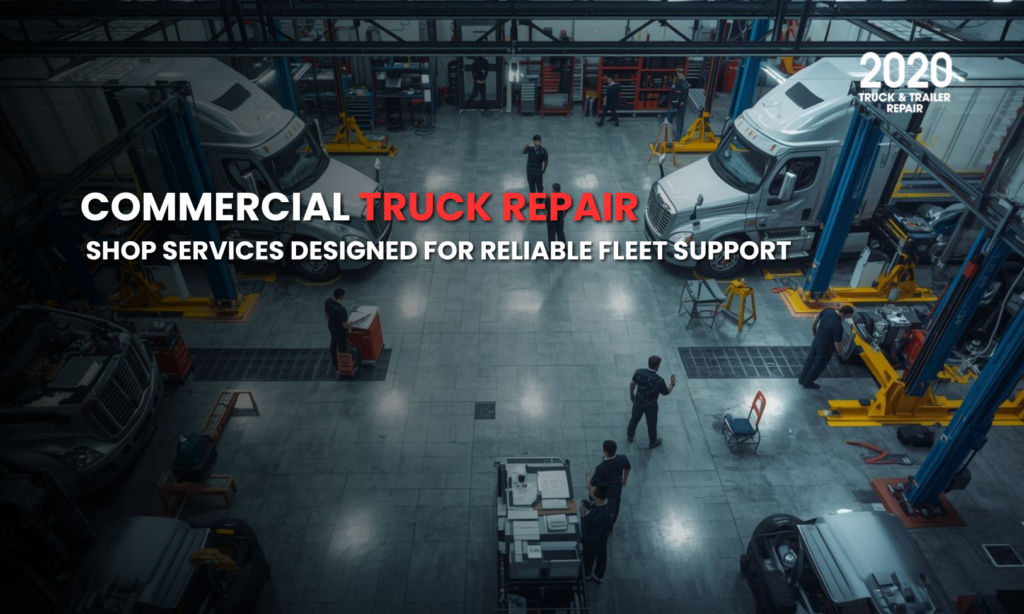
2020 Truck and Trailer Repair in Fredericksburg, Virginia is that shop for freight companies, construction operations, delivery businesses, and owner-operators across northern and central Virginia. Open around the clock at 46 Joseph Mills Drive, rated 4.8 stars across 65 verified Google reviews, and built specifically for the kind of work commercial operations actually need.
What Running Hard Actually Does to a Commercial Truck
Non-fuel operating costs for commercial trucking hit record highs in 2024, according to the American Transportation Research Institute. Equipment and maintenance costs across private fleets have climbed 76% since 2020. These aren’t abstract figures. They’re the reason fleet managers are under more pressure than ever to get more out of the trucks they already have, which means keeping them properly maintained and cutting down on the kind of failures that pull a vehicle off the road at the worst possible time.
Commercial trucks are working harder inside tighter margins. Longer routes, heavier loads, conditions that accelerate wear on brakes, suspension, tires, and drivetrain components. A truck that misses its PM service by 5,000 miles because the shop couldn’t fit it in isn’t just overdue. It’s accumulating risk that tends to cash out at the most inconvenient moment: a peak delivery week, a major contract haul, a Friday afternoon on a job site an hour from anywhere.
How a Good Shop Changes the Math
The difference between a commercial truck repair shop that works for a fleet and one that doesn’t isn’t always about technical capability. It’s about whether the shop keeps records, builds maintenance schedules around how specific trucks are actually being used, and communicates before problems compound rather than after they’ve already cost something.
At 2020 Truck and Trailer Repair, service history is tracked per vehicle. When a truck comes in, the shop knows what was done six months ago, what was flagged for monitoring, and what’s coming due. That context means the maintenance conversation starts from somewhere real instead of starting from zero every visit. Custom PM plans are shaped around each fleet’s actual operating patterns. Long-haul freight running high mileage runs differently than construction equipment doing short heavy-load cycles, and a generic service template doesn’t account for that gap.
The facility handles all major commercial truck brands like Freightliner, Volvo, Kenworth, Peterbilt, Mack, International, Hino, and Western Star. Engine work covers Detroit, Cummins, Paccar, and Caterpillar. Trailer repair spans dry vans, reefers, flatbeds, car haulers, dump trailers, lowboys, utility trailers, tow beds, and horse trailers. Full electrical diagnosis, transmission rebuilds, air brake work, DEF system service, DOT inspections with compliance documentation, suspension, wheel alignment, structural welding. The scope covers what keeps a working fleet operational.
When the Truck Can’t Come to the Shop
Some situations simply don’t allow for a tow and a shop visit. A vehicle down at an active construction site, a trailer with an electrical fault at a loading dock, a brake issue an hour outside of town. Waiting on a conventional service arrangement in any of those situations means losing the better part of a working day.
2020 Truck and Trailer Repair runs mobile service units out of the Fredericksburg location, dispatching within a 30-mile radius to wherever the truck is. On-site diagnostics, mechanical repairs, and scheduled maintenance visits happen at the fleet’s location. The service line runs 24 hours at (540) 507-9911 with no after-hours routing or next-morning callbacks. For construction fleets and delivery operations spread across Stafford, Woodbridge, King George, Culpeper, Spotsylvania, Manassas, and Richmond, that reach matters in a real way.
The Invoice Problem Nobody Talks About Enough
A shop quotes one number, finds something extra during the job, and the final invoice looks nothing like the estimate. For a fleet manager tracking maintenance costs across multiple vehicles, that unpredictability doesn’t just frustrate. It actively undermines budget planning.
The standard at 2020 Truck and Trailer Repair is transparent pricing with no hidden charges. If something unexpected shows up mid-repair, the call happens before the work does. What gets quoted is what gets charged. It sounds basic, but it isn’t universal in commercial repair, and it makes a measurable difference when you’re forecasting maintenance spend across a fleet calendar rather than reacting to surprises month after month.
Frequently Asked Questions -
What's the actual cost of skipping preventive maintenance?
Industry data puts unplanned downtime at an average of $760 per truck per day. Most unplanned failures have a detectable lead-up that a scheduled PM visit would catch. This includes worn brakes, developing coolant issues, or tire wear patterns. Catching it early costs a fraction of what a roadside failure does.
Which commercial truck brands does the shop service?
Freightliner, Volvo, Kenworth, Peterbilt, Mack, International, Hino, and Western Star. Engine work covers Detroit, Cummins, Paccar, and Caterpillar.
How does mobile service work for fleets?
Fully equipped units dispatch within 30 miles of the Fredericksburg shop for on-site diagnostics and mechanical repairs. Work that needs the full facility gets handled in-shop with a clear timeline communicated upfront. The same line handles everything, day or night.
How are custom maintenance plans structured?
Around the actual fleet: vehicle types, mileage, load conditions, usage patterns. Service intervals fit how the trucks are operating, not a pulled-from-a-shelf calendar. Records are kept per vehicle for compliance and forward planning.
Do you handle DOT inspections for fleet accounts?
Full DOT-compliant inspections on site, with documentation per vehicle to support fleet-wide compliance tracking over time.
Is there a minimum fleet size to set up an account?
No minimum. Single owner-operators and freight companies running dozens of trucks work through the same shop on the same terms.
Where is 2020 Truck and Trailer Repair?
46 Joseph Mills Dr, Suite 110, Fredericksburg, VA 22408.
Fleet operators who want a commercial truck repair shop built around reducing downtime, not just responding to it, can call 2020 Truck and Trailer Repair at (540) 507-9911 or visit 2020truckandtrailerrepair.com.